
what do you get when you mix two young farmers, lots of snow and 1400 pounds of alfalfa hay?
Haysplosion!
Now.... How did we arrive at said "haysplosion"?
Well it all started when the weather report was checked and it was determined that it was a "good day" to pick up a round bale of hay for the sheep. We arranged to buy one round bale of alfalfa (for a very good price) north of Potlatch. When we left home in the early afternoon, it had indeed begun to snow. by the time we got to potlatch, it had begun to seriously stick to the roads. At the farm outside Potlatch and somewhat higher in elevation, there was atleast a foot of snow on the ground. The tracks in the road out to the hay farm were most likely tracks from the farmer returning home from earlier errands.
We loaded up our one bale of hay. For those of you reading who have no idea just how large a "round bale" is... This farmer makes bales 5 ft wide and 6 ft in diameter. this thing took up 2/3 of our full-length truck bed and stood atleast a foot above the cab roof. It's estimated weight was 1400 pounds. It was just big enough that we could only fit one in the bed of the truck although that was probably a good thing, hindsight being what it is.
We made it back to Potlatch and stopped in Moscow for a snack and stretch break for the girls. By the time we got out to our farm, just south of Pullman, it was most decidedly dark however visiting the sheep was required to feed and water sheep that day, regardless of the hay bale in the bed of the truck. We drove past the gate and down to the fork in the road to turn around as usual. The right hand fork dips downhill and the left hand fork turns uphill. Normally, this is no problem for our truck but it IS the only place wide enough for the truck to turn around in one go. With the large amount of snow on the unplowed road and so much weight in the bed of the truck, we slid sideways downhill as we tried to turn. It took over an hour to get out. First trying momentum, then brute force, then rocking and so on. Second, Jason dug by hand while Margaret hiked back to the barn for snow shovels. By the time Margaret had fed the sheep and locked them in the barn for the night so as to not cause trouble while unloading hay, Jason had dug the truck out and managed to turn around.
We decided that it was not a good idea to attempt to drop off the hay that night.
The next day, we headed back out to the farm to drop off the hay. The barn sits at the bottom of the pasture. 2/3 of the barn stores hay. 1/3 of the barn is space for sheep (and goats). The pasture has a road graded between the gate and the flat bottomground in front of the barn specifically for vehicles to access the barn. The problem is that our gate is temporarily about 6 feet into the pasture and thus the grading is not wide enough for the truck to turn fully into the pasture and stay on the "road" even on a normal day. This day was definately not a normal day.
I am not sure why, but we decided to attempt to drive the bale down to the barn. What is the worst that could happen? We get stuck until the pastures melt and dry out enough for us to dislodge the truck and return it to the real road. As inconvenient as that would be, we are covered as far as another vehicle goes so nothing terrible there.
Jason starts down the hill with the intention of turning towards the barn about half-way down the hill and driving straight across the less sloped lower portion of the pasture to the barn. Forget the "road." About 1/4 of the way across the pasture in the process of turning the 90 degrees towards the barn, the truck begins to slide sideways down the slope. While trying to correct and maintain a course towards the barn, the nose of the truck met the lower fence and we were officially stuck. After a few hours of dismantling the bale of hay, flake by flake, and stuffing some under tires for traction, we manage to remove ourselves from the fence, back up our tracks (sort of ) by about 30 feet. Well, we were still stuck. Our biggest issue was that there was still enough hay in the bed to (relatively) remove weight from the uphill side tires so that they couldn't gain traction.

We decided then was a good time to bail with the rest of the hay bale. Since we were pushing uphill, we could not get rid of the 3/4 bale in it's entirety. we removed a total of about 1/2-2/3 of the bale in flakes, leaving several loose-hay piles next to the truck. We rolled what was left of the hay bale out of the truck and Jason went to get Eric (the landowner) to see if he might have enough tow chain to help pull us out with his more powerful diesel truck while I watered and hayed the sheep so we could keep them confined in the barn. That way we could return the next day to somehow move the hay to the barn so that sheep would not trample all of it while attempting to eat it.

Jason and Eric returned, surveyed the scene and left in search of every piece of chain on the farm property that may be of help wether it was 1 foot long or 60 ft long. We needed almost another hundred feet of chain in addition to our own 40 foot chain. We actually came down to requiring the last 1 ft section of chain but there was enough. We hooked it all together between the two trucks and began pulling our truck out of the pasture, about fifteen feet at a time. We reset and pulled again at least ten times since there wasn't much room on the road for Eric to maneuver his truck. We even took out the old gate post that we were intending to pull this year in the process! Eventually, something like 7 hours after the whole thing began, Eric managed to pull our truck all the way out. Hooray!
We emptied the last of our bale of hay from the bed just inside the gate and went home for the night. The next day, we returned with a cattlepanel intending to use it like a sled. As it turns out, cattle panels collect snow rather than sliding on top.
Thank goodness for Jason's mother! She suggested a large piece of plastic. We happened to have a roll of plastic we were using to cover broken barn and chicken coop windows that worked wonderfully. We loaded several hundred pounds of hay onto it at a time and it floated across the snow behind us.
We now have a loose-hay pile in the barn where we used to have several weeks of small bales of hay stacked. This bale of hay is supposed to last 2-4 weeks for us.
Now, we know how our grandparents felt at haying time and I sure hope that it's dry out the next time we need hay!
Now, having survived all that, Jason found a most appropriate video on YouTube. Enjoy!


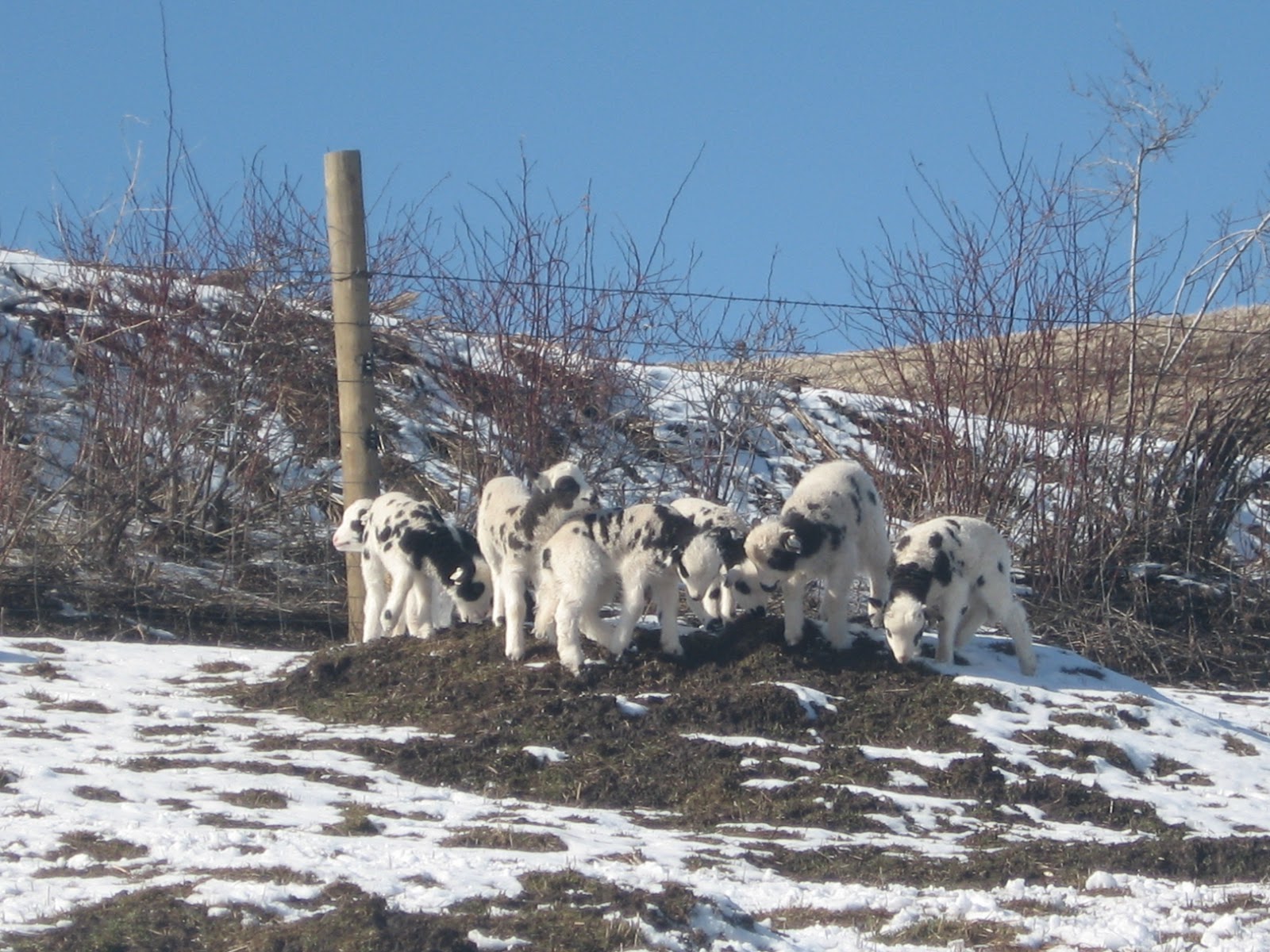


 And the best part of the day as a lamb?